You’re mid-transaction. A client is waiting on an invoice, or you’re trying to access e-CAC to check a tax obligation, and the screen in front of you is asking a question you weren’t prepared for: e-CPF or e-CNPJ? Most MEI owners guess. Some guess correctly, more by luck than reasoning. The ones who guess wrong find out the hard way, when the system rejects their certificate and the note doesn’t get issued.
If you’ve been wondering whether an e-CPF or e-CNPJ is better for a MEI business owner, this guide makes that choice straightforward. The certificate you choose determines which systems recognize you and which lock you out. Getting it wrong doesn’t just mean a wasted purchase, it means losing access at exactly the moment you can’t afford to wait. MEI owners who work with Auxílio Certificação Digital tend to sort this out in a single conversation, same day, before the confusion costs them anything. This guide gives you the same clarity, so you can make the right call before you spend a dime.
By the end of this article, you’ll know which certificate matches your MEI operation, what each one actually unlocks, how the A1/A3 format decision fits in, and where to get your certificate issued without a week of waiting.
What separates an e-CPF from an e-CNPJ at the root
Most people treat these two certificates as slightly different versions of the same thing. They aren’t. The difference isn’t about strength, validity, or legal weight. Both carry full legal force under the ICP-Brasil framework. The difference is about which identity each certificate is bound to, and that binding is what every system in Brazil uses to decide whether to let you in.
Your e-CPF is tied to your CPF number. When you authenticate with it, every government portal and digital system reads your identity as a natural person, a human being acting in their own name. Your e-CNPJ is tied to your CNPJ number. When you authenticate with it, the system reads the identity as a legal entity, the company itself acting through its representative. The technical and legal distinction isn’t about who is sitting at the keyboard. It’s about which subject the system is trying to verify.
For a traditional company with employees and a separate legal team, this is straightforward: the person signs with their e-CPF, the company acts through its e-CNPJ. For a MEI, the situation is genuinely more complicated. As a Microempreendedor Individual, you are simultaneously a natural person and a microenterprise. You have both a CPF and a CNPJ, and they’re attached to the same human being. That overlap is precisely why the e-CPF versus e-CNPJ question is harder for MEI owners than for any other business category. The certificate must match the identity the system is authenticating, not just the person who opened the laptop.
Which systems each certificate actually unlocks
Abstract rules about identity don’t help much at 3 p.m. on a Tuesday when you need to issue a nota fiscal. What helps is knowing, specifically, which portals and workflows each certificate covers.
With an e-CPF, you can access personal e-CAC flows for checking your individual tax records and INSS contributions, sign documents as yourself rather than as the company, and move through gov.br authenticated services that many MEI obligations run through, including PGMEI and Portal do Empreendedor. A significant share of MEI administrative tasks happen at the person level, not the company level, and e-CPF handles all of them. For many service-based MEIs, this covers nearly everything they need a certificate for.
The e-CNPJ is required when the system needs to recognize the legal entity behind the action. Corporate-level document signing in the name of the CNPJ requires it. Accounting and fiscal integration platforms like Integra Contador explicitly require e-CNPJ authentication. NF-e issuance workflows where SEFAZ treats the emitter as a company also require it. Some municipal NFS-e portals redirect to company-level authentication even for MEIs, depending on how the municipality built its system.
Some portals support both certificates, including e-CAC itself. The way to tell which one a specific flow needs is simpler than most people think: look at whether the system is asking you to authenticate as your CPF or as your CNPJ at login. That single indicator tells you exactly which certificate to reach for. The system is showing you its answer before you even try to log in.
Is an e-CPF or e-CNPJ better for a MEI business owner issuing notas fiscais?
If your MEI provides services, the federal NFS-e portal and most municipal systems allow access through gov.br or a simple access code. Under LC 123/2006, MEI businesses have exceptions built into the credentialing requirements. For most NFS-e issuances, a service-based MEI doesn’t need a digital certificate at all. Many MEI owners have been convinced they need an e-CNPJ to issue a service invoice when, in their specific situation, they can issue through gov.br without any certificate purchase. This surprises people.
It shouldn’t be a surprise. The law created the MEI category with operational simplicity as an explicit goal.
For MEIs that sell physical goods and must issue NF-e under Modelo 55, the situation is different. SEFAZ credentials the emitter as a legal entity, and the standard requires a company-bound certificate when issuing NF-e as a business. The XML document must be signed with an e-CNPJ. No e-CPF substitution works here, regardless of whether you’re the sole owner. If you sell products and need to transmit NF-e directly to SEFAZ, you need an e-CNPJ. That’s the clear answer for product sellers.
There is one practical exception worth knowing. MEIs who haven’t gone through full SEFAZ credentialing for NF-e can issue notas avulsas directly through the state portal using a username and password, no digital certificate required. This works as a stopgap, especially for MEIs early in their operation or those with low invoice volume. It’s not designed for high-frequency sellers. Once your product sales reach a consistent pace, moving through the full credentialing process with an e-CNPJ becomes the more functional path, both for volume and for cleaner accounting integration.
When an e-CPF is better for a MEI business owner
There’s a common assumption that every MEI eventually needs both certificates. That’s not accurate. A service-based MEI with straightforward operations can often run everything through an e-CPF and, in many cases, never need an e-CNPJ.
Picture a typical week for this kind of MEI: issuing service invoices through the federal NFS-e portal via gov.br login, checking INSS contribution history through e-CAC, signing a freelance contract as an individual, consulting their PGMEI dashboard for DAS payment status. Every one of these actions involves the person as either a natural person or a MEI with gov.br access. An e-CPF handles all of it. No e-CNPJ required.
The e-CPF is also the correct certificate for any document you sign in your own name rather than in the company’s name. Personal loan agreements, personal government forms, individual professional registrations, freelance contracts where you are the signatory as a person, all of these should be signed with your e-CPF. Using an e-CNPJ for personal document signing is actually the wrong move. The signatory on record becomes the company, not the person, which creates an identity mismatch in the document. Getting the right certificate also means knowing when not to use the other one.
When you need an e-CNPJ, and when having both makes sense
Some MEI operations reach a point where gov.br access codes and service invoice portals stop being enough. Certain triggers make e-CNPJ non-negotiable:
- Credentialed NF-e issuance for product sales
- Accounting and fiscal platforms that require company certificate authentication
- Signing contracts formally in the name of the CNPJ rather than as an individual
- Banking services that require company-level certificate authentication for business operations
There’s no workaround for these. A gov.br login handles MEI personal flows. It doesn’t substitute for an e-CNPJ when the system is specifically asking for a company certificate.
A common MEI profile that genuinely needs both certificates looks like this: a professional who provides a service and also sells a physical product, or a freelancer who manages personal tax filings alongside growing business obligations. One e-CPF for personal government services, e-CAC access, and individual document signing. One e-CNPJ for NF-e transmission and company-level fiscal operations. These serve different identity contexts. Neither replaces the other. The combined cost is still lower than most MEI owners expect when they first hear “you need both.”
The most common and costly mistake is trying to submit an NF-e with an e-CPF. The SEFAZ system rejects it because it expects a CNPJ-bound certificate. The note doesn’t get issued. The sale is delayed. Then the MEI has to purchase the correct certificate anyway, under pressure, often paying for rushed issuance. Getting the right certificate before the transaction is always cheaper than fixing the wrong one during it.
A1 or A3: which certificate format suits a busy MEI?
Once you’ve decided whether you need an e-CPF, an e-CNPJ, or both, there’s one more decision: A1 or A3. The format matters for cost, convenience, and how you access your certificate day to day.
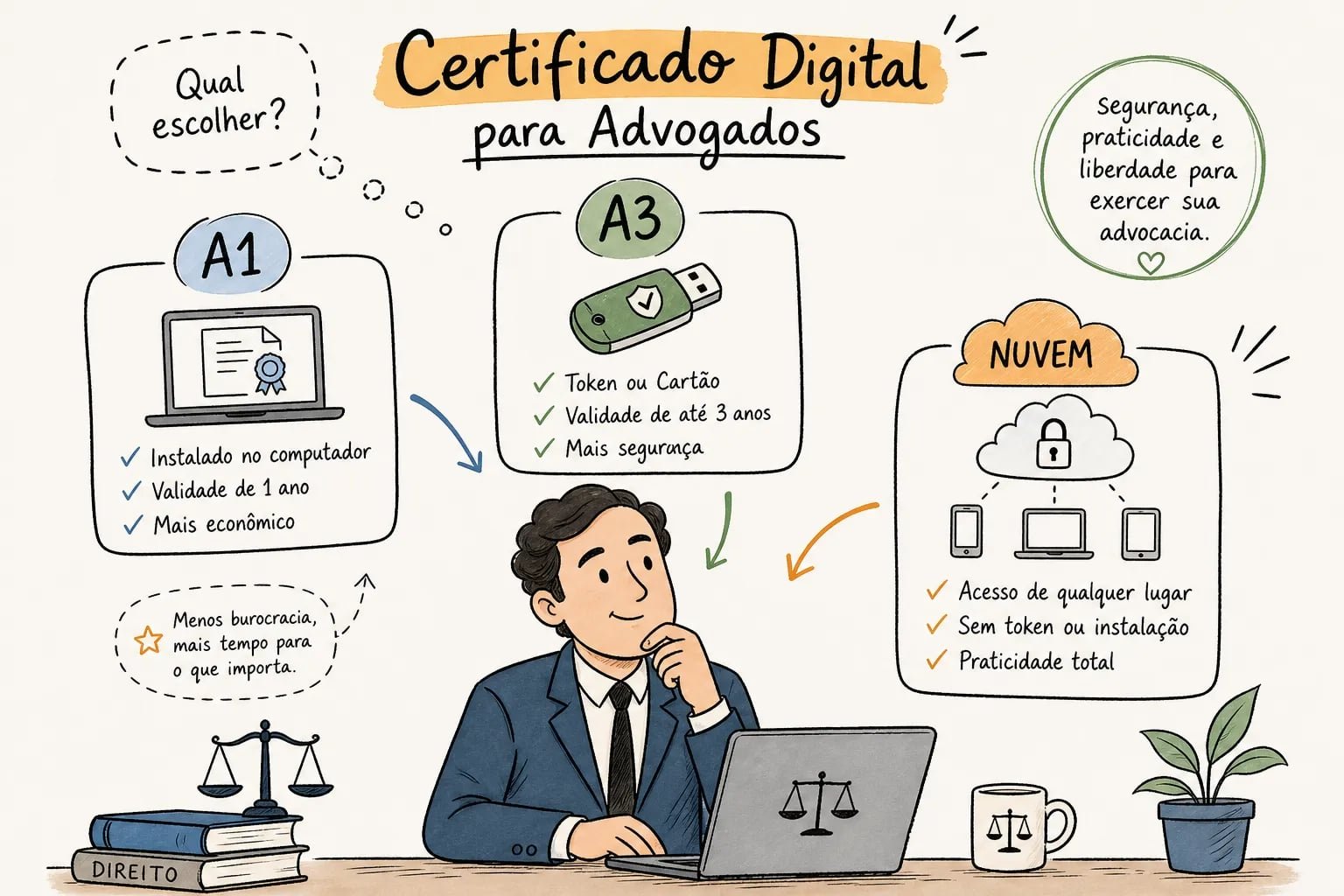
An A1 certificate is a digital file. It installs on your computer or device, no physical token, no smart card, no extra hardware. Validity is typically one year. For most MEIs, A1 is the practical starting point: lower cost, no hardware to manage or lose, and many ICP-Brasil authorized providers now offer same-day issuance via videoconference validation. The main limitation is that it’s device-specific by default. If you switch computers or your device fails, you need the backup file ready. Keeping a copy of your A1 certificate file in a secure location is a simple habit that saves real headaches.
A3 certificates offer longer validity (up to three years) and can be stored on physical tokens, smart cards, or cloud platforms. Cloud A3 options have grown in availability and let you access your certificate from any device without carrying a token. For MEIs who work across multiple devices or travel frequently, cloud A3 certificates are genuinely convenient. The tradeoff is a higher upfront cost.
For a MEI just starting out or running a focused, single-device operation, A1 is the better entry point. Pricing across ICP-Brasil authorized providers runs roughly R$119 to R$199 for e-CPF A1 and R$179 to R$280 for e-CNPJ A1, depending on the provider and included support. A3 makes more sense as your business scales, you move between devices regularly, or you want three years without renewal.
Getting your MEI digital certificate without the bureaucracy
Knowing which certificate you need is step one. Getting it quickly, correctly, and with support that doesn’t disappear after purchase is step two. Not all ICP-Brasil authorized providers deliver the same experience, and the difference shows up exactly when you need installation help or have a question during setup.
What matters for a MEI owner specifically: issuance that doesn’t require scheduling days in advance, a validation process that works via video call rather than requiring an in-person visit, pricing that reflects the actual scale of a micro operation, and human support that walks you through installation rather than sending you a PDF and wishing you luck.
Auxílio Certificação Digital is built specifically for MEI owners and small business operators, and the difference is visible from the first interaction. Both e-CPF A1 and e-CNPJ A1 certificates are issued via videoconference, with the validation call, document submission, and certificate delivery completing in a single session. After issuance, a human walks you through installation via WhatsApp, step by step, until the certificate is working correctly on your device.
For a MEI running solo who can’t afford a multi-day wait or a confusing installation process, that combination of hands-on support and streamlined process removes the friction points that typically cause MEI owners to delay getting a certificate they genuinely need. Check the current pricing and service details directly at Auxílio Certificação Digital’s site before purchasing, as rates and terms may vary.
The practical process looks like this: use this guide to decide which certificate type fits your operation, purchase online, complete the video validation call, receive your A1 file the same day, and install it with live support via WhatsApp. No office visit, no scheduling window to wait for, no abandoned installation. This is what certificate issuance should feel like for a business owner working on their own schedule.
The one-question framework: is an e-CPF or e-CNPJ better for your MEI?
Everything in this article distills to a single question: what identity does the system need from you? If the system needs you as a natural person, use your e-CPF. If the system needs you as a business entity, use your e-CNPJ. That distinction resolves almost every situation a MEI owner faces.
For service-based MEIs who issue NFS-e through gov.br or a municipal portal with login-based access, an e-CPF covers all certificate-related needs. For MEIs who sell physical products and need to transmit NF-e to SEFAZ as a credentialed emitter, an e-CNPJ is non-negotiable. For MEIs who do both, holding both certificates is the correct answer, and the total investment is still lower than most people assume before they check actual pricing with a provider.
The wrong certificate doesn’t just waste money. It costs access at the moment you most need it: mid-transaction, mid-deadline, mid-client relationship. So whether an e-CPF or e-CNPJ is better for a MEI business owner comes down to what your operation actually does, and now you have the framework to answer that clearly. When you’re ready to move forward, Auxílio Certificação Digital offers MEI owners a direct path to the right certificate, matched to the right identity, with hands-on support included from start to finish.